5 Common Garage Door Problems in San Antonio (And What to Do About Each One)
Most garage door problems fall into five categories: the door won’t open or close, the opener stops responding, the door makes noise, it moves unevenly, or a spring breaks.
Some of these have quick at-home fixes. Others need a technician to handle safely.
Knowing which is which can save you time and prevent a small issue from turning into a larger repair.
A garage door that works every day is easy to take for granted. You press a button, the door moves, you go on with your day. When it stops doing that, everything slows down. We get calls from homeowners across San Antonio every week about the same handful of problems. Most of them are recognizable. Most of them have a clear cause. And most of them are fixable the same day.
Here are the five we see most often, what typically causes each one, and what you can reasonably do about it before picking up the phone.
1. The Door Won’t Open
This is the call we get most often. You press the remote or the wall button, you might hear the opener hum, and nothing happens. Or the door lifts a few inches and stops.
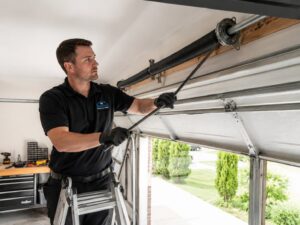
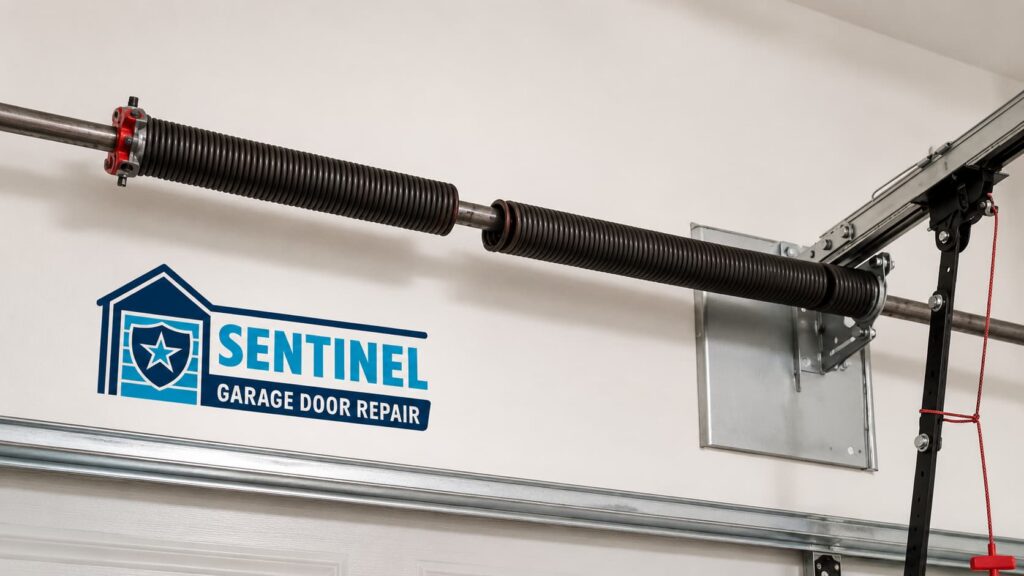
The most common causes are a broken torsion spring, a disconnected trolley, or travel limit settings that are off. A broken spring is usually obvious: you will hear a loud bang when it goes, and the door will feel impossibly heavy if you try to lift it manually. A disconnected trolley is trickier. The opener runs, the motor sounds normal, but nothing moves because the arm is no longer attached to the door.
Do not try to force a door open if you suspect a broken spring. The door is carrying its full weight without the spring’s counterbalance, and the opener was not built to handle that load. Disconnect the opener and leave it until a technician arrives.
Travel limit issues are simpler. The opener has settings that tell it how far to move in each direction. If those get knocked out of calibration, the door stops short of opening fully. That one is often adjustable from the opener unit itself. For a broken spring, you will need a garage door spring repair from a technician. Springs are under serious tension and are not safe to handle without the right tools and training.
A noisy door today is a broken spring tomorrow. Call Sentinel at (210) 864-9594 and we will diagnose it the same day, across San Antonio.
2. The Door Won’t Close
A door that won’t close is a security problem on top of a mechanical one. The two most common reasons are a blocked or dirty safety sensor and a travel limit set too high on the down direction.
Every automatic garage door has a pair of safety sensors near the bottom of the tracks. They send an invisible beam across the opening. If anything breaks that beam, the door stops or reverses. This is a required safety feature, and it works exactly as intended. The problem is that it is sensitive. A leaf, a small rock, a dusty lens, or a sensor that got bumped slightly out of alignment can all trigger it.
Before calling anyone, wipe the sensor lenses with a dry cloth and check that both sensors are aimed at each other with a solid light (not blinking). That alone fixes a surprising number of ‘door won’t close’ calls.
If the sensors look fine and the door still reverses or stops partway, the issue may be with the travel limit or, less commonly, a loose or damaged cable. Cables keep the door balanced as it moves. A frayed or off-track cable causes the door to bind on one side. That one is not a DIY fix. Garage door cable repair requires releasing tension safely before touching anything.
3. The Opener Stops Responding
We had a call from a homeowner in Stone Oak who was convinced her opener had burned out. She had already been pricing replacements online. When we arrived, the issue was a dead battery in the remote and a lockout switch that had been accidentally activated on the wall console. Five minutes, no parts, no charge.
That story is more common than people think. Before assuming the opener is broken, check three things: the battery in the remote, the outlet the opener is plugged into, and whether the wall console has a lockout button that was activated. Lockout mode disables all remote operation and is easy to trigger by mistake.
If the motor runs but the door does not move, the trolley may have disengaged. There is a red pull cord hanging from most openers for emergency manual operation. If someone pulled it and the trolley did not re-engage, the opener will run but nothing happens.
If none of those quick checks solve it, the problem may be inside the opener itself: a circuit board, a capacitor, or a worn motor. At that point it is worth having a technician look before buying a replacement. Some opener problems are a straightforward garage door opener repair. Others do need a full replacement. There is no point spending money on a new unit if the existing one can be fixed.
4. The Door Is Loud
A noisy garage door is not just annoying. Grinding, rattling, or squealing sounds are usually telling you something is worn or dry and needs attention before it fails completely.
Grinding or straining sounds
This usually points to the opener’s motor or drive system working harder than it should. The most common reason is a spring that is losing tension. As the spring weakens, the opener compensates by pulling more weight directly. You will notice the door gets slower and the opener gets louder. Left alone, this shortens the opener’s life significantly.
Rattling and shaking
Loose hardware is usually the cause here. Bolts, brackets, and hinges vibrate loose over time from the constant movement. A quick pass with a wrench on the visible hardware often makes a real difference. While you are at it, check the rollers. Worn or cracked rollers create a rough, chattering movement along the tracks instead of a smooth roll.
Squealing
Metal parts rubbing without lubrication. Apply a silicone-based lubricant to the rollers, hinges, and springs. Skip WD-40 as it evaporates quickly and leaves the metal dry again within a few weeks. A proper garage door lubricant takes a few minutes and often eliminates the noise completely.
Lubricate the springs, hinges, and rollers every six months. In San Antonio’s heat, metal expands and contracts more than in milder climates, and dry parts wear faster as a result.
5. The Door Moves Unevenly or Jerks
A door that hesitates, jolts, or travels faster on one side than the other is a door under stress. Some of the causes already covered apply here: loose cables, worn rollers, bent tracks. But the most common underlying reason is a door that is out of balance.
You can check this yourself. Disconnect the opener by pulling the red cord, then manually lift the door to about waist height and let go. A properly balanced door will stay in place. If it falls quickly or feels like it is fighting you going up, the spring tension is off.
Do not attempt to adjust spring tension yourself. The amount of stored energy in a wound torsion spring is enough to cause serious injury if released suddenly. This is one of the few garage door tasks where there is no safe DIY version.
An off-track door is another version of this problem. Sometimes a wheel jumps the track from an impact or from running too long on a worn roller. The door will bind on one side, move at an angle, or refuse to travel past a certain point. Garage door off track repair needs to happen before the door is used again. Running a door that is off track damages the track itself and can bend the door panels.
When to Call a Technician
Some of what is described above you can handle on your own: wiping sensors, tightening hardware, replacing a remote battery, applying lubricant. These are reasonable at-home steps that often resolve the problem.
For anything involving springs, cables, or the opener’s internal components, the right move is to call. Not because the repair is complicated in every case, but because the risk of getting it wrong is high. A mishandled spring or a cable under tension can cause real injury.
Sentinel Garage Door handles garage door repair across San Antonio, including Stone Oak, Shavano Park, Castle Hills, Leon Valley, and surrounding neighborhoods. Most repairs are completed the same day. If your door is giving you trouble and you are not sure what is causing it, call us at (210) 864-9594 and we will walk you through it.